
Island Peak Climb
-
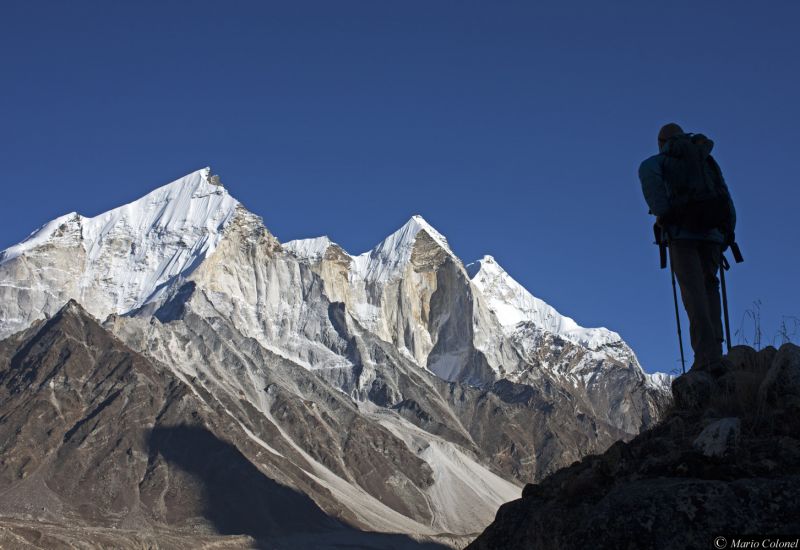
We follow the trail towards Nangpa la, the trading route between Namche Bazar and Tibet, a long been forbidden to Westerners but very much in use for the traders. The trek on this little trodden trail provides new visual perspectives on this area and passes through three of the highest passes in this region. This is arguably one of the most dramatic yet one of the most challenging treks in the Everest region. We trek across quaint Sherpa villages, monasteries, wildlife and dramatic mountain scenery of the area. We gain altitude gradually and enjoy a series of short trekking days, to ensure proper acclimatization. We then trek up the Bhotekosi valley and scramble across the Renjo Pass with breathtaking views of Everest, Lhotse, Makalu and Cho Oyu right in front of us. From Renjo we descend and down to Gokyo. The Gokyo valley is dominated by the massive form of Cho Oyu , at 8153 meters the eight highest peaks on earth. From here we can climb Gokyo Ri (5360m) to a view of all of the region's 8000-metre peaks including Everest, Lhotse, Makalu and Cho Oyu - a breathtaking panorama. We than walk beside the moraines of the Ngozumpa glacier and turquoise lake and make our way towards Cho La and enter into the Khumbu valley. The trail continues up to Kalapattar for more spectacular views of the surrounding mountains, including the incredible southwest face of Everest. The highlight of the race is the climb of Island Peak. The summit is interesting and attractive with a highly glaciated west face rising from the Lhotse Glacier. The mountain itself is the extension of the South Ridge of Lhotse Shar separated by a small col. The ridge rising to the south from this point leads to the summit of Island Peak. The extension of this ridge descending south-west is the part of the normal route of ascent and leads to the South Summit. Imja Tse not only provides an enjoyable climb but also provides some of the most spectacular scenery of Himalayas in the Khumbu region. We make our way back to Tengboche monastery, the religious lifeline of this area. We then descend down to Lukla and fly back to Katmandu the next day.
-
Days Activity Accomodation Meals Day 1 Arrival in Kathmandu Hotel D Day 2 Fly Kathmandu â?? Lukla, trek to Phakding Lodge BLD Day 3 Trek to Namche Bazaar Lodge BLD Day 4 Rest Day at Namche Bazaar Lodge BLD Day 5 Trek to Thame Lodge BLD Day 6 Rest Day at Thame Lodge BLD Day 7 Trek to Lungde Lodge BLD Day 8 Trek Lungde â?? Cross Renjo Pass - Gokyo Lodge BLD Day 9 Climb Gokyo Ri trek to Thagnak Lodge BLD Day 10 Trek Thagnak - Cross Chola pass and trek to Dzongla Lodge BLD Day 11 Trek Dzongla to Lobuche Lodge BLD Day 12 Trek Lobuche to Kalapatthar and back to Lobuche Lodge BLD Day 13 Trek Lobuche â?? Dingboche - Chukkung Lodge BLD Day 14 Trek to Island Peak Base Camp Lodge BLD Day 15 Climb Island Peak and trek to Chukkung Lodge BLD Day 16 Trek Chukkung to Tengboche Lodge BLD Day 17 Trek to Namche Lodge BLD Day 18 Trek Namche to Lukla Lodge BLD Day 19 Fly Lukla to Kathmandu, afternoon free Hotel BLD Day 20 Free day in Kathmandu Hotel B Day 21 International departure B -
Group Size Cost Per Person 2 - 4 Pax $ 5 - 8 Pax $ 9 - 12 Pax $ 12 Pax and above $ Single tent/room supplement $125 Cost Includes:
- Camping equipment during the climbing period at the Base Camp
- Accommodation in lodges during the trek as per itinerary
- Three meals per day including hot drinks like tea, coffee, hot chocolate as per itinerary
- Sagarmatha National Park entrance fees
- Trekkers Information Management Fees (TIMS).
- Island Peak Climbing permit
- Climbing Sherpa Climbing and Clothing allowance
- Sirdar and necessary sherpas for the trek
- Necessary porters for the trek
- Insurance for the porters and Nepalese staff
- Airfare for Kathmandu – Lukla - Kathmandu
- Hotel in Kathmandu for three nights on BB basis
- Welcome dinner in Kathmandu
Cost Excludes:
- Tips for Nepalese staff
- Personal expenses (bottled drinks, hot showers…)
- Personal travel insurance including evacuation of the trekkers
- Personal clothing and equipment for the trek
- International flights
- Nepalese Visa fees
- Lunch and dinner in Kathmandu
- Costs incurred due to unforeseen circumstances like landslides, cancellation of flights, political unrest, flood, rain etc.
-
Nepalese VisaThe Nepalese visa can be obtained at the Nepalese Embassy, Consulates or Missions abroad or at the immigration counter at the port of entry in Nepal. Multiple entry tourist visas are issued for a period valid for 15 days at US$ 25, 30 days for US$ 40 and 90 days for US$ 100 per person. You will require two passport size photos to acquire the visa.DocumentationApart from the visa you will require 3 different kinds of permits for this trek – Island Peak Permit, Sagarmatha National Park Permit and Trekkers Information Management System Permit. Please carry 8 passport size photos for the permits. We will help you acquire your permit in Kathmandu. Please note that the permit fees are already included in your cost. We suggest you leave your passport and your international air tickets with us here in Kathmandu. We will reconfirm your air tickets before your international departure.Nepalese timeNepal time is ahead by 5h45 than international GMT.During winter if it is 12h00 in France it is 16h45 in Népal.During summer it if is 12h00 in France it is 15h45 in Népal.Food on the trekFood during tea house treks is based on the best available food in the lodges. Normally all three meals are included in the price along with tea or coffee and biscuits when you arrive in the lodge.For camping period our mobile kitchen crew serves Nepalese, Indian and Continental fare during camping treks. Bread, butter and jam with eggs are usually served for breakfast which is occasionally accompanied by muesli, granola and porridge. Hot chocolate, coffee, tea and juice are served. The crew could surprise you with cakes, pies and pizza.Support staffAll our Tour Leaders have undergone leadership training and have had intensive courses on mountain medicine, first aid and are capable of handling emergency situations. They are deep understanding and knowledge of the mountain culture and are familiar with high altitude survival skills. Our support crew (except the porters) are usually sherpas who have been the backbone of the trekking industry in Nepal and the team usually has years of experience between them and so our team is prepared for all eventualities in the mountains. The preservation of the fragile Eco system is of utmost importance to us and our support staff is made well aware of the significance of preserving the environment. We conduct regular orientation programs to educate our support crew regarding the importance of conservation of our environment. We take pride in the high quality of service we render – personalized, professional and above all enjoyable. Our crew with a keen sense of hospitality will make your holiday worthwhile. You will make friends with our tour leader during the trip and find adventure that you will re-live the rest of your life.Best SeasonIt is best to visit this region in spring and autumn.• Spring generally begins in March and ends in May. Though there is a slight haze the forests covered with a riot of scarlet coloured rhododendrons, primulas, daisies, white magnolias and a host of other beautiful plants making a trek an exhilarating experience.• Mid September heralds the beginning of the autumn season. Mid September to mid November enjoys excellent climate coupled with deep blue sky and clear days making this period the best trekking period of the year.Trek EquipmentFor camping period we provide state of the art equipment that comprises of two men North Face Tents, Mess tent, Kitchen tent, Toilet tent, Shower tents, folding chairs, tables, cooking utensils, fuel (kerosene or LPG), all cooking appliances, mattresses, shower pumps, folding toilet seats and gamow bags in case of high altitude treks.TransportationDriving is on the left in Nepal but your vehicle may be a left-hand drive, meaning you alight into the traffic – please take care. Comfortable jeeps, vans or tourist coaches will be provided for all transportation depending on the size of the group.PhotographyThe whole world uses digital photography these days. The sunlight is very bright during the daytime due to the thin air so please take that into account while filming. Not all of the monasteries and places of interest are open for filming. Some places levy a small amount for every picture taken while in some places it is strictly prohibited so it is advisable to seek the advice of your guide before you take a photo.Group sizeThe size of the group could vary from 2 - 16 people. Though we can manage larger groups due to group dynamics we only operate groups up to 16 people. We have limited number of people in all our departures to ensure personalized service. We try and make sure that the need of each and every client is attended to and he/she feels comfortable and can enjoy the amazing culture, landscape and people better and have a great holiday.Responsible TourismThe ecology of the Himalayas is very fragile. Responsible and sustainable tourism has always been our main thrust and mantra so that the environment and its resources- natural or cultural – always remain intact for the future generations to savor. We strongly advise that all non-biodegradable items such as can, bottles, batteries, plastics etc to be brought back to Kathmandu for proper disposition. We discourage the use of bottled mineral water to control the plastic bottles' waste. Since water is essential while traveling at such high altitudes we advise our clients to carry sturdy water bottles so that they can fill them up with hot water that is treated with water purifiers. As a part of our responsible tourism drive we use local guides and locally owned hotels (wherever possible) so that the people can earn income from direct employment or through the distribution of work responsibility.Packing ListThe weather in Nepal can vary significantly, and the best advice is to take clothing that will layer to cover all eventualities. It may easily be cold in the evenings and when walking at higher altitudes.• Clothing and Footwear• Warm down jacket for the cold• Warm clothes• Spare clothing - several thinner layers are better than one thick layer• Walking boots - well worn-in, with good ankle support and strong ridged soles with good tread, and spare boot laces• Trekking boots - Windproof/waterproof trousers and jacket with hood, good rain gear: It is quite likely to rain at some point whilst you are out.• Sun protection: sunglasses with UV protection• Loop-pile socks - one thick and one thin pair reduces the risk of blisters• Long trousers and long-sleeved shirts to provide protection from the sun• Sun hat - although it is unlikely to be too hot, the sun may be very strong• Comfortable clothes - for evenings and comfortable shoes for sightseeing• Lightweight survival bag - A small rucksack - a bin liner will keep contents dry if it rains• Balaclava/ warm Cap - Scarf/ mask• Windbreakers/ Jacket• Down Sleeping bag• Towel - if you intend to go swimming and for use on the trek (bath towels are of course supplied in hotels)• Torch - essential as not everywhere has electricity and the mains supply can be erratic• Adapter - sockets may be large or small, 3 round pin or 2 round pin. Voltage is 220• Money belt• Fold-up bag for souvenirs• Camera• Umbrella• Equipment/ Toiletries• Flashlight• Sunscreen/ Lip balm (high factor sun screen and lip protection)• Water bottle: with at least 1 litre capacity• Moisturizing lotion• A knife with a can opener• Insect repellentMedical KitWe provide a first aid kit with medication for altitude sickness, nausea, dehydration, pain killers, and medication for dysentery, diarrhea, bandages, water purifier, antiseptic creams, throat lozenges, eye drops, antibiotics, nasal sprays, and pain relievers in tubes or spray but it is advisable to carry some medication on you without taking too much room in your baggage.• Asprin or Panadol - for pain or fever• Antihistamine - useful as a decongestant for colds, allergies, to ease the itch from insect bites and stings or to help prevent motion sickness• Antibiotics-useful if you are traveling well off the beaten track but they must be prescribed• Kaolin preparation (Pepto-Bismol)• Imodium or Lomotil - for stomach upsets and to stop diarrhea and dehydration• Rehydration mixture - for treatment of severe diarrhea and dehydration• Antiseptic, Mercurochrome and Antibiotic powder or similar 'dry' spray-for cuts and grazes• Calamine lotion-to ease irritation from bites and stings• Bandages and band-aids- for minor injuries and wounds• Scissors, Tweezers and a Thermometer• Throat Lozenges• Acetaminophen (paracetamol)• Antacid tabletsHealthPrevention is always the best cure. So take care in what you eat or drink. Travelling in Nepal does not involve major health risks provided simple precautions are observed.• Drink bottled water. Reputable brands of bottled water or soft drinks are generally fine. Take care with fruit juice, particularly if water may have been added.• Do not take ice; be wary of uncooked food including salads, fruit juice and ice-cream; remember that milk is usually unpasteurized• Do not bathe in freshwater rivers and lakes, and maintain a high standard of personal hygiene.• Wash your hands frequently and clean your teeth with bottled water.Please remember to pay attention to sensible hygiene at all times and to follow any advice given by your guide – it is essential to avoid illnesses.Altitude sicknessSometimes travelers face health hazards mainly due to the high altitude. Acute Mountain Sickness (AMS) is a frequent problem in the Himalayan region and can affect a traveler is various ways irrespective of their age, gender or health fitness. Even if you are in perfect health and peak fitness, you can still develop AMS. Previous experience of high places, pre-ascent training and good physical shape do not prevent the onset of altitude sickness - it can strike anyone of any age. Our body normally time to be acclimated to the high altitude. The body undergoes a number of physiological changes some of which are increased pulse and respiratory rate. Others appear slowly over a period of weeks like the change in acid base balance and production of extra red blood cells. These changes and the effect of intense sunlight, strenuous walks and dehydration may cause some mild or vague symptoms such as:• Loss of appetite• Fatigue• Headache• Nausea• Dizziness• Palpitations• Sleeplessness• BreathlessnessThe condition is caused by lower than normal levels of oxygen being absorbed. If the sickness is acute, you can become confused, irrational and mentally unbalanced. The best way to counter it is prevention. You should not exert yourself or walk too fast. Drinking plenty of liquid, eating well and watching for warning sign is highly advised. Aside from following your guide's advice, you can try to eat a diet that is high in carbohydrates to build up glycogen in the muscles, avoid unnecessary vigorous activity in addition to the trek or climb and do not ascend faster than you need. Keep physical activity to the minimum and take regular doses of diamox as directed by your physician. IF the symptoms do not recede then do not hesitate to talk with our staff. Our trekking teams carry a Gamow bag (a portable compression chamber) to be used in severe cases. If you have a history of respiratory and heart problem please consult your physician before embarking on this trip. But based on our years of experience, with proper preparation and time taken to acclimatize, severe cases are relatively rare. Though we will ensure that you are safe and at worst will suffer only the mildest of symptoms it is best to listen to your body; no-one knows it better than you!VaccinationImmunisations currently recommended for Nepal are those for Hepatitis A and Typhoid. Ensure also that you apply insect repellent liberally and do not expose bare skin to mosquitoes after dusk. Meningitis is a risk in certain areas of Nepal at certain times of year and you should consult your doctor as to whether immunisation is necessary..Physical fitnessSince the above trip entails traveling at high altitude it is necessary that the client is in good health. Before you embark on any one of these trips it is advisable to be physically and mentally fit and prepared. Prepare yourself by jogging or walking at least one hour daily for a minimum period of one month. A thorough health check up is strongly recommended before the trip.Medical FacilitiesThere are many pharmacies which sells medicines and some have a doctor’s clinic. Prescription is not a requirement for purchase of harmless drugs in Nepal.InsuranceInsurance All the clients are strongly advised to have personal travel insurance covering trip cancellations or interruptions due to natural disasters or medical reasons, insurance against emergency evacuation, medical and accident insurance. You will need to leave your insurance details in our office in Kathmandu during the trip so that we can make necessary arrangements should the need arise.Risk and LiabilityOur trips mean safety, reliability and the professional personnel to ensure your convenience at all times. However sometimes unforeseen circumstances like landslides, floods, bad weather, bad road condition, vehicle breakdown, delay in flights due to bad weather, local political situation could contribute to the change in the program. No claim of refund will be entertained including early return from the trip, or change in itinerary due to unavoidable situations like the above. All extra expenses (apart from the services offered as per the program) that occur in such cases would have to borne directly by the clients themselves.
AT16KH03
21 Days
Tea House
It is imperative that you have some sort of previous trekking experience to undertake this trek. They are physically demanding and technical climbing of some sort is desirable. Since this trek requires walking in rugged and sometimes extreme conditions it is advisable to start the trek on a positive note and adventurous frame of mind. Walking hours may vary from 7 ? 8 hours and you may be required to walk at an elevation of 4000 ? 5000 meters.


